Dental implants
Replaces the root of a missing tooth with a titanium base that fuses with the bone.



In charge Santiago Palacio (Oral and maxillofacial surgery), Amanda Herrera (Oral rehabilitation) and Yulissa Ceballos (Periodontics)
Total duration
3 to 6 months, including bone integration
Anesthesia
Local, sometimes with sedation
Care
Like a natural tooth: brushing, flossing and check-ups
An implant replaces the root of a missing tooth with a titanium post that fuses with the bone and serves as the base for a crown, a bridge or a fixed prosthesis. It’s one of the questions we get most often at Oralmaax, and it’s already part of the solution in several of our treatments, such as prosthetics, maxillofacial surgery and oral rehabilitation.
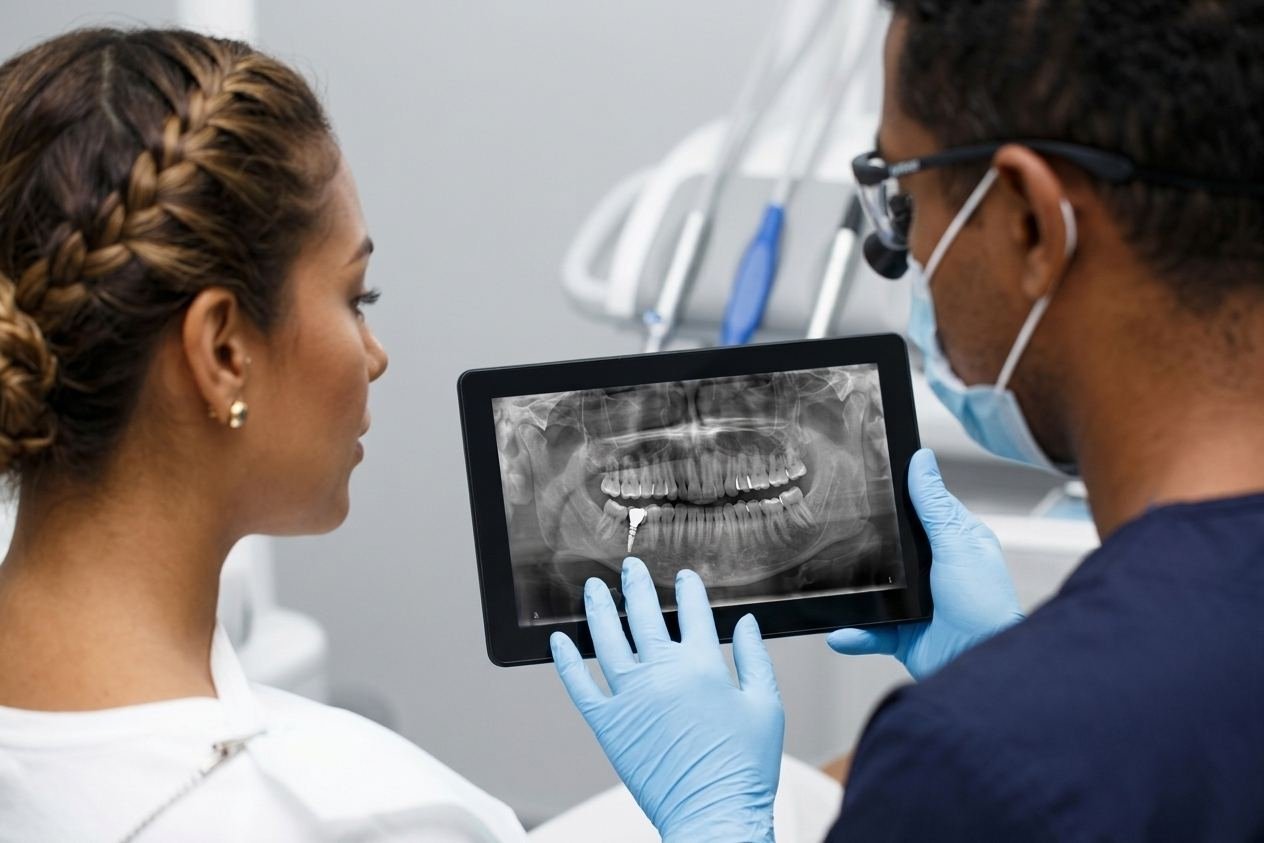
Once it has fused with the bone, an implant feels and works very much like a natural tooth: you chew normally and don’t have to take it out to sleep or clean it. The surgeon places the implant and the oral rehabilitation specialist designs the crown, so both plan the treatment together from the start.
What it includes
- Evaluation with an X-ray or CT scan to measure the amount and quality of the bone.
- Case planning and, if needed, a bone graft before placing the implant.
- Surgery to place the implant, with local anesthesia.
- Time for the implant to integrate with the bone (a few months) and placement of the final crown.
When does it make sense?
If you lost a tooth to decay, trauma or extraction, if your removable denture feels loose or uncomfortable, or if neighboring teeth have started to shift into the gap, it’s worth evaluating an implant. It requires enough bone and healthy gums; if bone is missing, a graft can be done first.
“Restoring the whole tooth, from the root.”
When should you consider a dental implant?
You lost a tooth to trauma, decay or extraction
The gap stays unrestored and affects chewing or appearance.
Your removable denture is uncomfortable or loose
An implant gives you a fixed base, with no need to take it out to sleep.
Neighboring teeth have started to shift
A gap left open for a long time can move the surrounding teeth.
Treatment options
Single implant
Replaces one missing tooth with its own individual crown on the implant.
Implant-supported bridge
Several teeth in a row restored with a fixed bridge supported by 2 to 4 implants, instead of one per tooth.
Bone graft beforehand
When there isn't enough bone to hold the implant, a graft is done before placing it.
Frequently asked questions
Does implant surgery hurt?
With local anesthesia the procedure shouldn't hurt; there may be some discomfort in the following days, managed with common pain relievers.
How long does the whole process take?
Between 3 and 6 months in total, because the bone needs to integrate with the implant before the final crown is placed.
Can anyone get an implant?
You need enough bone and healthy gums. If bone is missing, a graft can be done before surgery.
How do you care for an implant?
Like a natural tooth: brushing, flossing and regular check-ups with your specialist.
Other services you may be interested in

Teeth whitening
Lightens your teeth and removes built-up stains and discoloration without touching the tooth's structure.
See details
Smile design
Veneers, contouring and whitening combined for a more balanced, natural-looking smile.
See details
Endodontics
Root canal treatment to save the tooth instead of extracting it.
See detailsReady to book your dental implants?
Payment plans available, plus special prices for Coomeva and Protección members.